If you're building a social enterprise, there’s a chance you’re not the paper-chasing type. You don’t dream of corner offices, private jets and fat wallets.
In fact, business in general may not even excite you. What does excite you is the potential to make a real difference in people’s lives.
You’ve seen injustice, inequality or unmet need and can’t unsee it. And that’s precisely what makes you the type of person the world needs more of.
Yet there’s a side to mission that’s often overlooked. And that’s margin. Time and again, we meet social entrepreneurs who pour everything into their mission but underestimate the importance of financial sustainability. They may even hesitate when it comes to talking about profit.
And we 100% get it. Talking about money can feel uncomfortable or even at odds with the heart of your work.
But the truth is, if you’re building a social enterprise, business should excite you.
Profit isn’t a dirty word. It’s the thing that powers your mission. Because the more money your enterprise makes, the more lives you can change.
Ultimately, a mission without a profit engine is on borrowed time. It will struggle to last, let alone grow, which is why finding that balance between mission and margin isn’t optional when you’re building your social enterprise, it’s essential.
Profit isn’t the enemy of purpose
When you’re driven by impact, it is easy to treat revenue as something that will sort itself out later.
Many early-stage founders tell us their focus is on changing lives, not making sales. But without financial stability, even the most promising ideas can stall.
A social enterprise that can’t sustain itself eventually becomes dependent on external support, and that creates pressure, limits growth and makes long-term impact much harder to achieve.
Profit strengthens your mission
Healthy revenue with good defensible margins fuels sustainable impact. It allows you to keep serving communities you care about, and it funds innovation, better tools and systems and the ability to serve more people.
Here’s what else financial sustainability creates:
Ability to show up consistently
When revenue is steady, work can flow. There are no sudden pauses, no scrambling to keep the lights on and no sleepless nights wondering if you’ll make payroll. A financially sustainable business can show up for its community confidently, day after day, year after year.
Freedom to grow on your terms
Consistent income means you can plan, hire or expand when it makes sense, not when you're desperate. As a result, your growth decisions come from a place of strategy, not survival.
Resource to strengthen your work
Strong revenue lets you improve your offering, upgrade your systems and build better processes. Those improvements flow directly to the people you serve, creating a deeper and more lasting impact.
Better outcomes for communities
Financial health translates to reliable support and consistent service. When your enterprise is strong, the people who depend on it aren’t left wondering if you’ll still be there tomorrow.
Resilience to handle uncertainty
A sustainable business can handle rising costs, changing demand and unexpected challenges. That resilience protects your mission and gives it room to adapt rather than fold.
Where to begin
Ready to find that balance? Start by honestly answering these questions.
Can you clearly explain how your enterprise makes money from value-added sales of a product or service?
Not your mission, not your impact model but your revenue model. If someone asked you right now how money flows into your business beyond grants and donations, could you walk them through it in a couple of sentences? If not, that's your starting point.
Can you clearly explain how your product or service will compete with existing or new competitors?
This is about your brand promises. Brand promises fall into three main categories: quality, cost or reliability.
Mission-oriented businesses often rely only on the brand promise that is their social mission. While values absolutely matter, this is never enough on its own to sustain long-term demand.
Sure, people may choose you once because of your mission but they return because your product or service is genuinely good.
If you’re not promising something unique, customers won't return. And you need them to return because re-purchase is the key to a financially sustainable business model.
Do you know your numbers?
What will your customer be willing to pay for your product or service? What will it cost to produce that product or service? How many products or services can you sell in a month or a year?
What does it cost to serve one person or complete one project? You may not need complex financial models yet, but you do need to understand whether the math can work in your favour.
Is your pricing sustainable?
Are you charging what your product or service is actually worth or are you under-pricing because it feels wrong to make a profit from mission-driven work?
Are you planning to differentiate your product or service simply because you’re a mission-oriented business.
Some mission-led choices, like one-for-one models, ethical sourcing or recyclable materials, are genuinely commendable. But these ideas cost far more than your competitors’ cost models.
If you're planning initiatives like these, you have to then charge higher prices for your product or service to cover these costs and still make a competitive margin.
Sustainable pricing isn't greedy. It's what keeps you in business long enough to create real impact.
See mission + margin in action
Meet Irene from MAMLO Foods; one of the entrepreneurs in our 2025/2026 cohort.
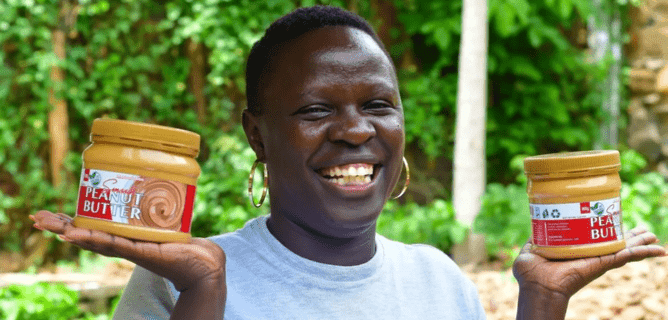
In Kenya, rural women farmers remain price-takers while profit is made further down the supply chain. Most crops like peanuts leave farming communities raw with the highest margins captured by middlemen and distant factories.
Kenyan food scientist, Irene Etyang, created MAMLO to change that.
MAMLO is building community-embedded processing infrastructure including standardised container-based processing units placed directly in farming communities.
These units turn peanuts into branded, high-value peanut butter and operate as independent commercial facilities, not livelihood projects.
Women run the units, process peanuts into premium products like peanut butter and participate in the economics of the business itself. Wages, profit-sharing and reinvestment are tied directly to unit performance.
In this model, farmer income isn’t assumed. Instead, it’s structurally linked to how well the business performs.
How MAMLO balances purpose and profit
MAMLO’S revenue doesn’t come from asking customers to support a cause. It comes from competing as a serious food brand.
The product is designed to win on taste, quality, consistency and reliability – the same standards that apply to any premium product on the shelf.
The mission matters, but it’s not the sales pitch. Customers choose MAMLO because the product stands on its own and they return because it performs.
“We’re very clear that our impact depends on having a strong, commercially viable product,” Irene explains.
“People don’t buy our peanut butter solely because of our mission. They buy it because it tastes great and performs like a premium brand should.”
“The margins that come from that are what allow us to create jobs, share profits with farmers and keep expanding into new communities.”
“MAMLO’s very existence is to prove that local ownership, value addition and income growth can be built into the core of a commercially disciplined food business.”
Become an All Good Venture
If your business exists to create freedom, opportunity or safety for marginalised communities, your mission is clear. The challenge now is building the commercial strength that will let that mission last.
That’s where we can help.
Every year, we walk alongside up to 5 social entrepreneurs, giving them money (seed funding), mentoring (to develop and implement a business strategy) and muscle (access to free or subsidised guidance from other professionals).
By the end of the 1-year programme, each entrepreneur has not only grown their business but built the foundations for self-sustaining impact in the communities they serve.
Plus, if their business requires more capital, they’re in a place where a solid business strategy, clear financial targets and well-defined action plans can be communicated with potential investors.
Applications for our 2026 programme open 1 to 31 March.
If you’re an early-stage founder with a purpose-driven idea and a commitment to building a financially sustainable enterprise, we would love to hear from you.
Check the full criteria to find out whether our support could help your mission grow.
Words by Hannah McCreery at Two Sides